
Your cart
There are no more items in your cart
- Dr.ssa Marina Putzolu
- 0 likes
- 30721 views
- 0 comments
Lactose intolerant people know which certain foods they should not consume and which ones they can eat safely. But discovering all this is not always that simple.
Once you have been diagnosed with intolerance, following a more or less frequent symptom, you go home with a thousand doubts, and the lucky ones with a leaflet that contains some "forbidden" foods.
Lactose-free products , very common in almost all supermarkets, can be easily included in a daily diet, in this way it is also possible to take away some whims, for example by buying lactose-free sweets (we specify that extra dark chocolate is a lactose-free chocolate). As a milk substitute, on the other hand, you can opt for vegetable drinks such as almond milk, just to name one.
The real problem lies when, once in front of the PC, you look for more information on the net and sometimes you are faced with the most disparate foods.
For this it is necessary to clarify and dispel some myths.

Lactose is so called, as it is milk sugar . It is therefore easy to understand that milk and derivatives (cheeses, dairy products and products made with milk) must be eliminated .
But that's not always true!
Aged cheeses , due to a completely natural process, tend to decrease their lactose content, until it becomes almost minimal.
A common example is Parmigiano Reggiano and Grana Padano.
Until recently, the aforementioned companies indicated the consumption of their products only if they were aged for more than 30 months.
But for some time a note has appeared on the website of the Parmigiano Reggiano company that we quote here:
“Parmigiano Reggiano does not contain either lactose or galactose. In the hours immediately following the cheese-making, a rapid development of lactobacilli takes place, which ferment all the lactose present in the curd in about 6-8 hours. Galactose, which is formed from lactose, is also rapidly metabolized within 24-48 hours and disappears completely. Perfect for all those who are lactose intolerant. " | 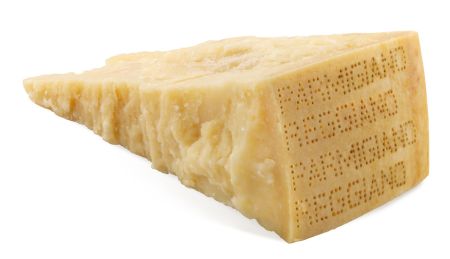 |
For a level playing field, we can say that the same is also true for Grana Padano . On their official website you can clearly read:
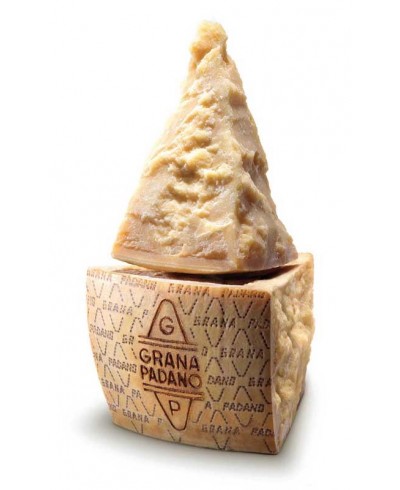 | “The traditional production process of Grana Padano PDO, strictly defined by the Production Regulations, allows to obtain a naturally lactose-free cheese, which can therefore be easily consumed even by those who are intolerant. The production process of Grana Padano PDO ensures that lactose is gradually eliminated during the natural cheese making process. Most of the residual lactose in the whey separates from the curd at the time of cheese making. In the curd there is still a limited fraction of whey and soluble components of milk, including lactose. Later, already during the forming phase, which lasts 48 hours, lactic fermentation takes place and the bacteria break down almost all the residual lactose, transforming it first into glucose and galactose and then into lactic acid. It is during the first phase of maturation that the degradation of the remaining lactose takes place. After 9 months, the minimum aging period provided for by the Regulations for Grana Padano PDO, the residual lactose is much lower than 0.1 g / 100 g (limit value indicated by the DGISAN Min. Health Circular 06.16.2016). Grana Padano PDO can therefore also be consumed by lactose intolerant adults and children, who can thus enjoy the extraordinary nutrients provided by raw cow's milk and its bioactive properties, without compromising their health. " |
Therefore, it is no longer necessary to purchase, and therefore consume, these products with a maturation of more than 30 months, but it is also possible to do so for shorter times.
It must be said, however, that some lactose intolerant people cannot digest well even a food with residual lactose less than 0.1 g / 100 g of product.
Therefore, paying attention to food labels and finding your balance is therefore essential.
A similar argument can also be made for another very famous product, gorgonzola .
Also in this case we can read on the website www.gorgonzola.com of the Consortium for the Protection of Gorgonzola DOP cheese: After the experimentation organized by the Gorgonzola Consortium in collaboration with the CREA Research Center in Lodi, it is possible to state that "The lactose content in Gorgonzola was well below the ministerial limit to define a" naturally lactose-free "cheese (<0 , 1 g / 100g). " | 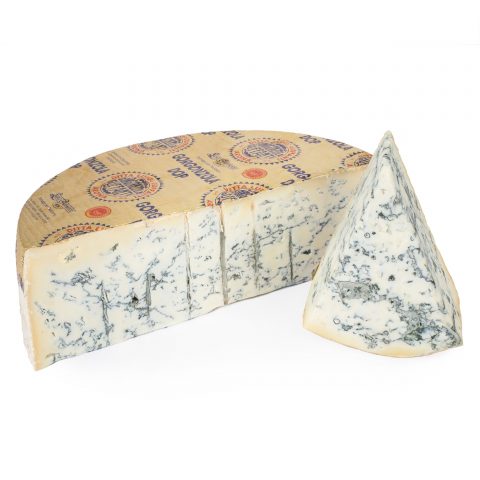 |
Other cheeses that can be consumed, but in moderation, as in this case the tolerance is very subjective, are:
- Aged pecorino
- emmentaler
- gruyere
- fontina
- Provolone
- Cheddar
For yogurt, the situation is more complex. In general, it could be consumed by lactose intolerant people, as the content of this sugar is low (article on yogurt). In any case, lactose-free yogurt can also be purchased on the market.
On the other hand, all those products that naturally do not contain lactose, but to which it is added as an additive during the processing phase, deserve a separate discussion.
This is the case with stuffed meats such as ham, salami, mortadella . But not all companies use it.
In fact, we can list the products that are certainly suitable for lactose intolerant:
| |
Finally, we can include in the list of foods containing lactose, all industrial or artisanal products that however show on the label if lactose is present.
In fact, the presence of lactose, milk, milk powder, etc. will be indicated in bold, so in this case you can rest assured, just give a reading to know immediately whether or not you can consume that food.
False information on the web
As I mentioned earlier, some fake news circulates on the web - false information about some foods that may (or may not) contain lactose.
Two examples are very important to mention:
- Foods of vegetable origin: DO NOT contain lactose . So yes to all vegetables, vegetables and fruit. Do not pay attention to fake lists that are occasionally found on the web.
- Goat's milk CONTAINS lactose , although it is often recommended on the web, or by some uninformed traders.
We always remember that if you consume food outside the home , and you are not sure that your meal is lactose-free, opt for the use of a good lactase supplement such as LACTOSOLUTION 15000 ( HERE the link to the shop ) .

Comments (0)