
Your cart
There are no more items in your cart
- Dr. Marco Verducci
- 11 likes
- 157705 views
- 0 comments
We have already addressed the study of the generic lactase enzyme here . We then delved into the different types of active lactase enzyme here .
Now is the time to focus on the amount of enzyme offered in commercial products and on how much to take.
Whether we are talking about lactase or beta-galactosidase (to find out more click here ), the concepts I am now explaining when talking about enzymes and lactose intolerance are valid in both cases.
When I started studying these supplements, as a lactose intolerant, I discovered that there is no single and clear definition of the amount of enzyme contained in a commercial dose (one tablet, one capsule, in general ... a nutritional supplement).

Some supplement manufacturers, in fact, use an international FCC nomenclature and others Italian UL, still others write ALU and others U! Knowledgeable people in the industry helped me understand.
I try to explain it in a simple way, your comments will make me understand if I did a good job or not.
1st FCC - Food Chemical Codex
This is the most used wording, it will be easy to find the FCC writing next to the declared number in the packages of supplements.
According to an international standard, it identifies the enzymatic activity, that is the ability of the enzyme to carry out its task of breaking down lactose into glucose and galactose.
Specifically, the quantity of enzyme that is able to release 1 micromol of 1 substrate (o-nitrophenol) per minute is measured, at the temperature T = 37 °, and at the acidity condition pH = 4.5.
In reality, the more correct wording would be "FCC ALU" as FCC refers to a standard valid for different types of food ingredients such as vegetable oils, fructose, whey and amino acids, flavoring agents, vitamins and functional food ingredients, and only the addition of ALU indicates that we are talking about lactase.
2nd ALU - Acid Lactase Unit
Although we can find it written by itself, the abbreviation ALU without company of other terms is incorrect. It is based on the FCC standard just explained and is therefore equivalent to FCC.
It is therefore correct to write "FCC ALU".
We can often find the words ALU / g , which expresses the concentration or quantity of enzyme per gram of active ingredient. This value does not indicate the amount of enzyme present in a product , so packages that only report this are unclear.
Indeed, in some packages, I found the word ALU as a unit of measurement next to a numerical datum of 10'000 or 100'000. In this case the error is evident and the wording could only refer to a value in ALU / g.
There seems to be confusion also among the producers or, at least, among the compilers of the supplement packaging texts.
This causes entropy in the user and, if you are not an expert, you will end up misinterpreting the labels.
The aforementioned concentration in fact varies from 10,000 ALU / g to 160,000 ALU / g. As stated above, ALU / g is equivalent to FCC / g.
What does this value tell us, in practice?
Little or nothing to the user. Instead, it tells the manufacturer how big the enzyme tablet will be.
Let's take an example for ALU / g:
LACTOSOLUTION 15000 contains 100'000 ALU / g lactase enzyme from Aspergillus.
This value is equivalent to 100 ALU / mg (we went from grams [g] to milligrams [mg]).
Wanting to offer 15,000 FCC in a single dose of product, how many mg of enzyme would we need?
It is immediately calculated: quantity of enzyme in FCC to be proposed over the concentration, that is 15,000 / 100 = 150 mg.
That's why in LACTOSOLUTION 15000 you find written 150 mg of lactase enzyme from Aspergillus for each tablet.
In summary, case 1 (real):
- Lactase enzyme quantity in FCC: 15'000 FCC ALU
- Lactase enzyme quantity by weight: 150 mg
- Concentration: 100'000 ALU / g
- Compressed size: 7 mm
- Tablet weight: 220 mg (including excipients)
What if we had used 10'000 ALU / g lactase (equivalent to 10 ALU / mg) instead ?
We would have had to create tablets with 1500 mg of enzyme inside (1.5 g = 15,000 / 10) to have the same ability to digest lactose.
Our tablet would be much larger, perhaps going from 7 mm in diameter to 12 mm.
Would you buy a tablet that you couldn't swallow?
In summary, case 2 (imaginary, hypothetical):
- Lactase enzyme quantity in FCC: 15'000 FCC ALU
- Lactase enzyme quantity by weight: 1500 mg = 1.5 g
- Concentration: 10'000 ALU / g
- Hypothetical compressed size: 12mm
- Hypothetical tablet weight: 2000 mg = 2 g (including excipients)
3rd U or UL - Lactase Unit
Often, very often, you can find on the packages written "Lactase Unit" or "U" or, again "UL" next to the number that expresses "the power" of the supplement (from 500 to 15000).
These are Italianized terms of the aforementioned FCC and ALU, thus being completely equivalent to FCC ALU .
If instead, as already announced, next to U or UL you find figures similar to 100'000, it means that the manufacturer has made a mistake and that value refers to ALU / g. In this case you have no other way to know the quantity in FCC ALU of the tablet if not by comparing the value in "mg" shown on the label (mandatory by law) and using the inverse formula to that applied in the examples.
Given the 3 entries, we can draw our own conclusions.
Ultimately we can say that:
ALU = FCC = FCC ALU = UL = U
(values from a few hundred to 15,000 per tablet)
different from ALU / g
(standard values of 10,000, 100,000 or 160,000)

For completeness of content and to provide real examples, we report what is written on the packaging of two widely used supplements:
LACDIGEST:Active ingredient: Beta-galactosidase Amount of enzyme declared in "Units": 2'250, equivalent to 2'250 FCC ALU Enzyme quantity declared by weight: 22.5 mg Concentration: 100'000 ALU / g |  |
PROLIFE ZERO LACTOSE:Prolife zero lactose intolerance, lactase enzyme. LactosolutionProlife zero lactose intolerance, lactase enzyme. Lactosolution Active ingredient: Lactase Amount of enzyme declared in "U": 4'500, equivalent to 4'500 FCC ALU Enzyme quantity declared by weight: 45 mg Concentration: 100'000 ALU / g | 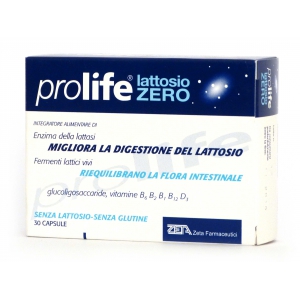 |
LACTOSOLUTION 15000:Lacdigest lactose intolerance, lactase enzyme. LactosolutionLacdigest lactose intolerance, lactase enzyme. Lactosolution Active ingredient: Lactase Amount of enzyme declared directly in "FCC ALU": 15'000 Enzyme quantity declared by weight: 150 mg Concentration: 100'000 ALU / g Once again, pay attention to the active ingredient! ( read here ) |  |
It would now seem easy to understand what quantity of lactase we need to digest a certain weight of lactose , but it is not so.
We remember ( we covered it here ) that the digestion of lactose depends on the following factors , as well as on the amount of lactase taken:
- The amount of lactase the body produces
- The amount of lactose you will eat
- The digestive capacity of food
To these we add, entering the technician, the ability of the enzyme to reach the intestine without compromising its functionality . It is in fact in the intestine that the lactose breakdown takes place and it is here that we have to add lactase.
What depends on reaching the right point, at the right time, of the enzyme taken?
From two main factors: from the ability of our stomach to attack the substances that arrive from the mouth and from the packaging (delayed-release capsule, immediate-release capsule, sachet, tablet ..).

It is now clearer why an enzyme tablet is to be taken at the same time as a meal and instead a capsule is generally recommended to be taken one hour before, differently from when recommended by the clock!
The cellulose in the capsule is more resistant to stomach acids and the release of the enzyme occurs with a delay, especially if the capsule has been designed for delayed release (delayed release capsules).
This does not change that the enzyme, sooner or later, will find itself in the same conditions and will have to pass through the stomach unscathed. Through empirical studies we can say that at least 30% of the enzyme does not reach the intestine .
Here is a first fundamental factor that gets our formulas high on the ability of a product, with a certain "weight" of lactase, to make us digest a food containing a certain weight of lactose.
As for the amount of lactase enzyme that our body naturally produces, we can refer to the Breath Test . It gives us a picture of the second factor that invalidates our calculations of lactase functionality based on ingested lactose.
What we eat also affects the ability of the supplement, thanks to the pH ( here the deepening ).
Assuming all these hypotheses, it is extremely difficult to give a univocal answer on the subject . However, we can affirm that: the product that can make us more likely to digest the food with the lactose we want to take is the one with a high lactase content (FCC value greater than 12,000) .
Fortunately, there are products with 15,000 FCC ALUs per dose. This quantity does not involve any side effects but ensures good digestion even in subjects who do not have any production of lactase within their body.
Forget about being intolerant. Try LACTOSOLUTION 15000 now .

Enjoy your meal!

Comments (0)